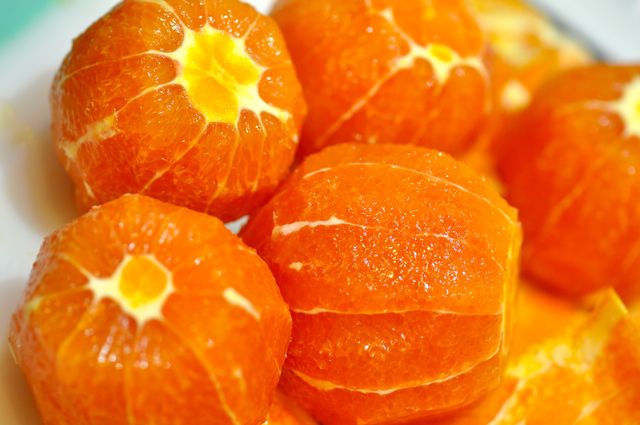
Traditional methods of peeling and supreming citrus require cutting each individual segment off the pith. I think that is wasteful since the pith is quite tender and edible, so why cut it away and lose additional flesh and juice? My method yields manageable slices while preserving more fruit.
The following technique works best on citrus with thick skin, such as navel and Cara Cara oranges, grapefruits and small pomelos. Thin skinned oranges such as Valencias and juicing Florida oranges will work too, but will be messier.
Tools
A thin, long blade sharp knife works best. I like to use a super sharp meat carving knife for its control and grip. Use a cutting board reserved for fruits and vegetables only (preferably with indentation along the perimeter to catch the run off juices). Do not use cutting boards that have been previously used with raw meat, no matter how clean you think you may have washed it. Residual bacteria may still remain in the grooves and may contaminate your fruits. Don’t chance it. Buy a cutting board that’s dishwasher safe and reserve it for fruits and vegetables only.
How-To
Wash you hands well. Thoroughly wash the oranges and pat dry with a clean kitchen towel. Most citrus are coated with wax and have pesticide and/or mildew inhibitor residues on them. It’s easy for these chemicals to get on your hands and leach into the cut flesh of the citrus, so take the time to wash and dry the fruits before cutting them. You may want to use fruit/vegetable wash instead of just washing with water alone (Trader Joe’s makes a good, naturally derived one), especially if you see the telltale white residues on the skin of the fruits.
Set the orange on its side on the cutting board and slice off the top and bottom of the orange. Make the cut just deep enough for the blade to remove the white pith.

Set the flat bottom of the orange in the middle of the cutting board and slice vertically down one side, making about an inch strip for a medium-sized orange, and cutting deep enough to remove the white pith but not so deep as to remove too much flesh. It’s ok to cut conservatively and maybe leave little streaks of white pith on the flesh. You can come back later and cut them off.
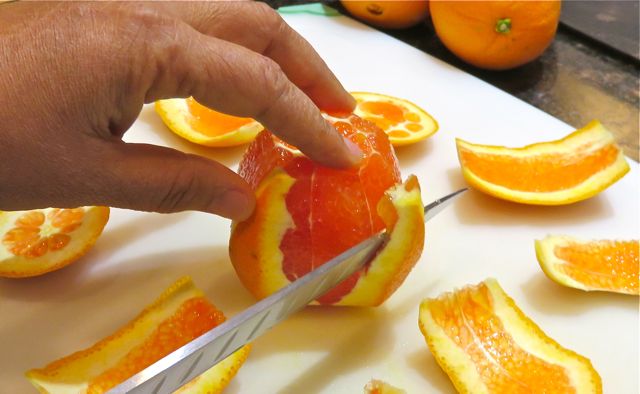
Rotate the orange 180 degrees and cut a similar vertical strip opposite the first one.
Rotate the orange 45 degrees and cut another strip, then rotate the orange one more time 180 degrees to cut the fourth strip. By now your orange should look something like this:
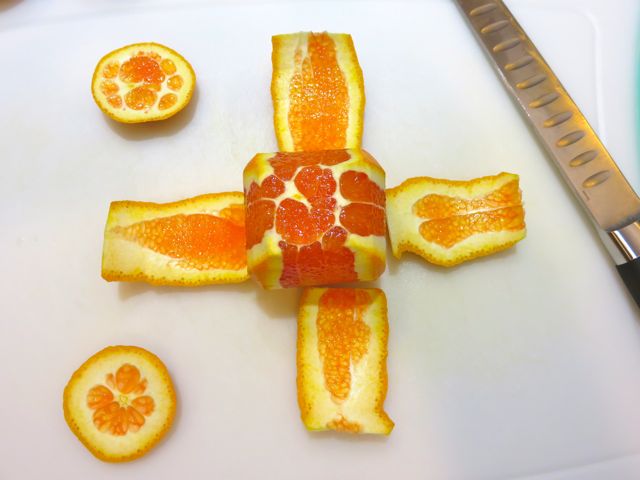
Repeat the sequence again for the last remaining four strips, then cut off any remaining white pith left on the orange. Set the peeled strips in one pile and the white pith in another.

Why all the rotation in this particular order? Why not just slice the peels off one by one sequentially all the way around the orange? Because as you begin to peel the orange it will become squishy and hard to hold, and you’ll get more uniform results and less bruising if you top and bottom cut, then rotate the orange 180/45/180 degrees.
The now completely peeled orange may be cut into rings and then into half-moons for a nice salad (try mixing with shaved fennel bulb, fruity olive oil and Fleur de Sel).
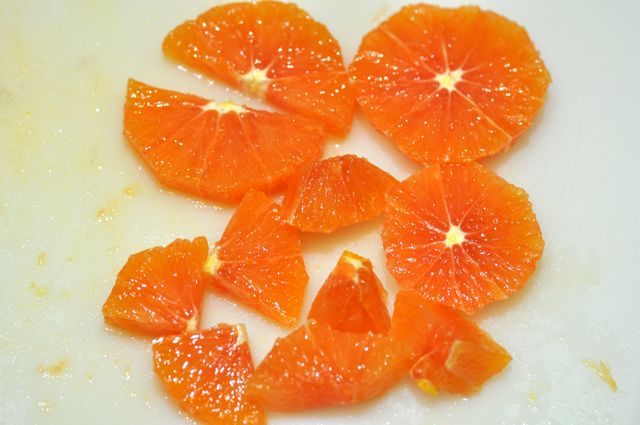
Or they may be cut into supreme-like slices the following way:
Hold the orange vertically and slice down the middle just to the right of the center white pith. Further cut the sliced piece lengthwise into thirds.
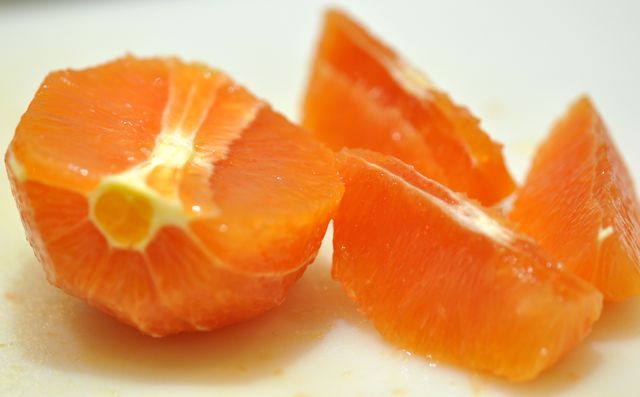
Cut individual slices around the pith (3-4 slices depending on orange size), laying the last slice flat on the cutting board and cutting off the center white pith.
The slices may be left whole or cut in half into chunks for fruit salad.

Optional: Grab a handful for reserved white pith and squeeze juice over the cut fruit. If you cut too much flesh off when peeling, you can also squeeze the peels to extract juices. It’s a tedious task, but a ten pound bag of oranges will yield about 1/2 cup of juice extracted from the flesh left on the pith and peels (yes, I actually measured this). If you can’t be bothered, then just discard into the compost heap.

